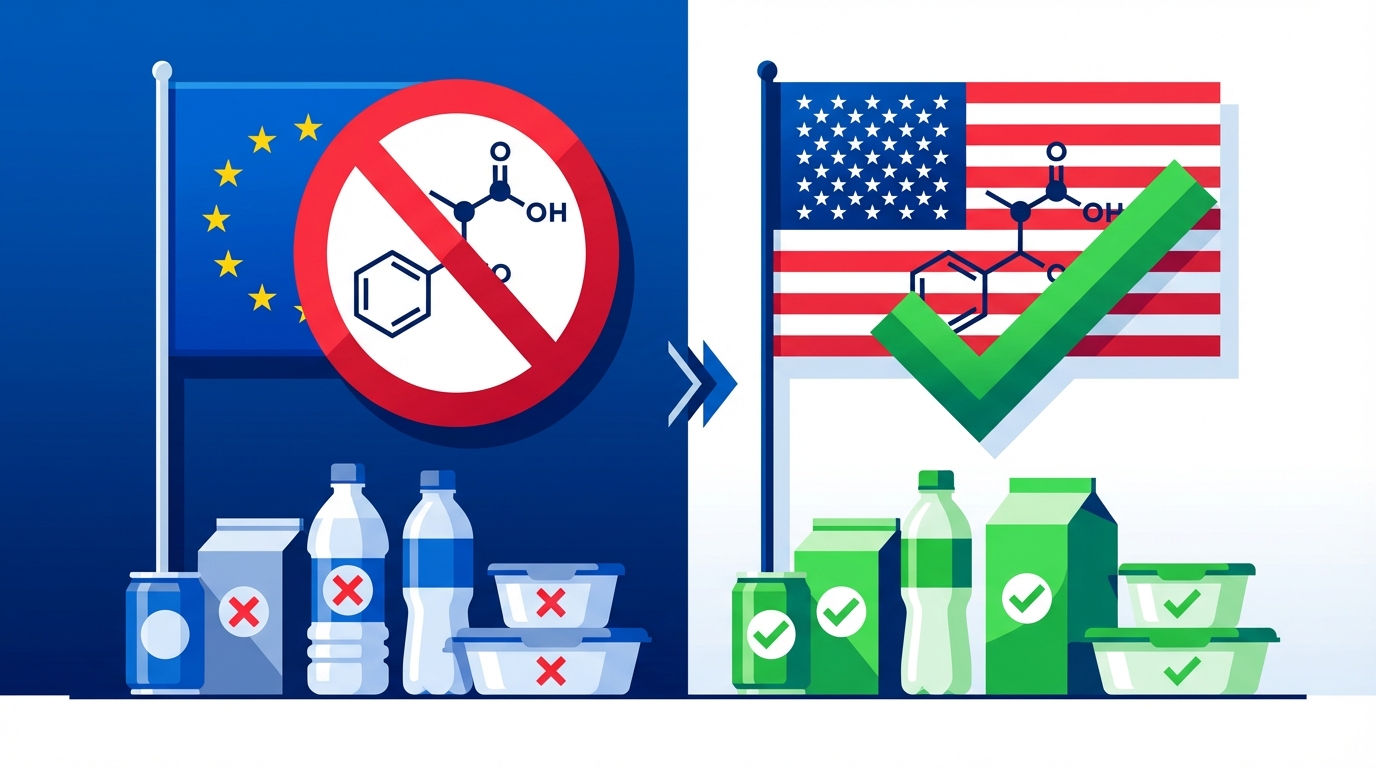
EU Bans BPA in All Food Packaging While FDA Calls It 'Safe'
On January 20, 2025, Commission Regulation (EU) 2024/3190 took effect across all 27 European Union member states. It banned bisphenol A (BPA), bisphenol S (BPS), and other hazardous bisphenols from every category of food contact material: plastics, can coatings, varnishes, adhesives, printing inks, rubber, silicones, and ion-exchange resins. No government has ever passed a broader restriction on bisphenols.
That same day, the FDA's official position remained unchanged: "BPA is safe at the current levels occurring in foods."
Two of the world's largest food regulators looked at the same chemical and reached opposite conclusions. One acted. The other has not responded to a legal petition for over 1,320 days.
Why BPA Matters
BPA is one of the most produced chemicals on Earth. Manufacturers have used it in food packaging since the 1960s, primarily in the epoxy linings of metal cans and in hard polycarbonate plastics. It leaches from packaging into food and beverages, especially when heated.
BPA mimics estrogen and interferes with hormonal signaling. A CDC survey found that approximately 95% of Americans tested carry detectable BPA in their bodies. Children show the highest levels.
Researchers have linked the chemical to reproductive harm, immune system disruption, and developmental effects. For decades, regulators treated these links as uncertain. In 2023, Europe's food safety authority decided they were not.
What EFSA Found: 20,000 Times Too High
The EU ban rests on a sweeping reassessment the European Food Safety Authority (EFSA) published in April 2023. EFSA reviewed studies that earlier assessments had excluded, then concluded that the tolerable daily intake (TDI) for BPA should be 0.2 nanograms per kilogram of body weight per day, as Maricel V. Maffini and Linda S. Birnbaum reported in Environmental Health News in May 2024.
That figure is 20,000 times lower than the previous threshold.
For an average adult, the revised TDI works out to roughly 12 nanograms per day. A single serving of canned food can deliver exposure many times higher. EFSA's assessment found that BPA exposure across all age groups exceeded the new TDI, meaning no level of dietary BPA exposure in Europe was considered safe under the updated science.
EFSA used "nonstandard studies" that, according to Food Safety Magazine, amounted to "a more modern" approach. The key finding: BPA causes harmful effects on the immune system, specifically on T-helper cells, a type of white blood cell. This immune disruption occurs at doses far below what previous safety evaluations had flagged.
What the EU Ban Covers
The European Commission adopted the regulation on December 19, 2024. It prohibits bisphenols in seven categories of food contact material, according to the Commission's Access2Markets portal: plastics (including reusable water bottles, food containers, kitchenware), varnishes and coatings (including can linings), printing inks, adhesives, ion-exchange resins, silicones, and rubber.
The phase-out follows a staggered timeline:
- July 20, 2026: Non-compliant single-use articles may no longer be sold
- July 20, 2028: Single-use packaging for produce and processed fishery products with BPA-containing varnishes must be off shelves
- January 20, 2028: Deadline for repeat-use professional equipment to first enter the market under old rules
- January 20, 2029: Final deadline for previously placed repeat-use professional articles
Two narrow exemptions remain, according to PackagingLaw.com: polysulfone filtration membrane assemblies (needed for microbiological food safety where no alternatives exist) and liquid epoxy resins for self-supporting articles exceeding 1,000-liter capacity. Even in these cases, BPA migration must stay below 1 part per billion (1 ppb), and items must be cleaned and flushed before food contact.
The regulation also bans BPS (bisphenol S), the compound many manufacturers adopted when marketing products as "BPA-free." This closes a loophole consumer advocates had flagged for years: swapping one harmful bisphenol for a structurally similar one. Other bisphenols classified as category 1A or 1B carcinogenic, mutagenic, or toxic to reproduction, or as category 1 endocrine disruptors, are also prohibited.
"Today's ban, which is based on solid scientific advice, will protect our consumers against harmful chemicals," Commissioner Oliver Varhelyi said when the regulation was adopted.
New Research: Effects at Even Lower Doses
The EU ban was already in force when an Uppsala University study, published in Communications Medicine (a Nature portfolio journal), added fresh evidence against BPA.
Researchers exposed Fischer 344 rats to BPA during fetal development at a dose approximately eight times lower than EFSA's already-reduced TDI. They then examined bone marrow gene expression and blood metabolic profiles later in life.
In males, BPA shifted the transcriptome toward a hypermetabolic, autoimmunity-like state with increased T-cell activity, suggesting a dysregulated immune response. In females, the shift ran the other direction: toward a hypometabolic, cancer-like state with inflammation, altered blood markers, and decreased T-cell activity. The researchers described the pattern as "female masculinization" and "male feminization" at the molecular level.
Two things make these findings hard to ignore. They show biological effects at a dose below the safety threshold EFSA used to justify the ban. And they provide a mechanistic explanation, immune disruption via T-cells, that directly supports EFSA's rationale for lowering the TDI by a factor of 20,000.
The FDA's Silence
The FDA has maintained its position that BPA poses no risk at current exposure levels.
The American Chemistry Council (ACC), the primary industry trade group for chemical manufacturers, calls BPA concerns a "pervasive myth" on its website. The ACC cites the CLARITY program (Consortium Linking Academic and Regulatory Insights on BPA Toxicity), which it describes as the largest BPA study ever conducted. CLARITY's principal investigator said "BPA did not elicit clear, biologically plausible, adverse effects" at typical consumer exposure levels. The ACC also quotes former FDA Deputy Commissioner Dr. Stephen Ostroff: "Our initial review supports our determination that currently authorized uses of BPA continue to be safe."
The science has moved on since CLARITY wrapped up in 2018. EFSA's 2023 reassessment incorporated newer research and different methods, reaching a fundamentally different conclusion. The Uppsala study found effects at doses well below what CLARITY examined.
In 2022, the Environmental Defense Fund (EDF) and allied organizations filed a formal petition with the FDA requesting two actions: revoke approvals for BPA in adhesives and can coatings, and set strict limits on BPA in food-contact plastics. Federal law gives the FDA 180 days to respond.
As of January 2026, the agency had not responded.
"It's been 1,320 days since the agency filed our petition," EDF wrote. "FDA has not yet made a decision on our petition, despite a legally-mandated 180-day deadline."
EDF was blunt about the implications: "That inaction is a decision. It means BPA continues to be allowed in the foods American families eat every day."
Maffini and Birnbaum wrote in their Environmental Health News analysis: "The European Food Safety Authority has the freedom to follow the science, while the US Food and Drug Administration has stagnated."
The gap between US and EU regulation of BPA is not about scientific disagreement. It is about regulatory will.
The "BPA-Free" Problem
For years, products marketed as "BPA-free" gave shoppers a false sense of security. Many simply swapped BPA for BPS, a structurally similar chemical.
The EU regulation addresses this by banning BPS alongside BPA. It also covers any bisphenol classified as a serious hazard to human health, blocking the industry from substituting one problematic compound for another.
No such restriction exists in the United States. Products labeled "BPA-free" may contain BPS or other bisphenol analogs, and consumers have no way to know.
The FDA did ban BPA from baby bottles and sippy cups in 2012. But manufacturers had already voluntarily stopped using BPA in those products. The regulation codified an industry practice that had already ended.
What This Means for You
If you live in the EU, this ban will gradually strip bisphenols from your food packaging over the next several years. Single-use items phase out by mid-2026, with longer timelines for specialized equipment.
If you live in the United States, you are largely on your own. Here is what you can do to reduce BPA exposure today.
Cut back on canned food. Most metal can linings contain BPA. Choose fresh, frozen, or products packaged in glass or cartons when you can.
Never heat plastic containers. BPA and other bisphenols leach faster at higher temperatures. Do not microwave food in plastic, even containers labeled "microwave safe."
Treat "BPA-free" labels with skepticism. A product free of BPA may still contain BPS or other bisphenol analogs. The label tells you what is absent, not what is present.
Look up product safety data. Apps like VeriFoods let you scan product barcodes and check whether items have been flagged for contaminants, including bisphenols, heavy metals, pesticides, and PFAS. Independent testing data fills gaps that labels leave open.
Push for regulatory accountability. The FDA's 1,320-day silence on the EDF petition is not normal. Consumer pressure has historically driven food safety action in the United States.
EFSA found the previous safety threshold was 20,000 times too high. Uppsala researchers found effects at doses eight times below even that revised limit. The EU acted on that science. The FDA has not.
Stay ahead of the label.
Get early access to VeriFoods and be the first to see what's really in your food.
Sources
- European Commission Food Safety, "Commission adopts ban on bisphenol in food contact materials," December 19, 2024. https://food.ec.europa.eu/food-safety-news-0/commission-adopts-ban-bisphenol-food-contact-materials-2024-12-19_en
- European Commission Access2Markets, "EU Prohibition on Use and Trade of Bisphenol - 20 January 2025," January 2025. https://trade.ec.europa.eu/access-to-markets/en/news/eu-prohibition-use-and-trade-bisphenol-20-january-2025
- Food Safety Magazine, "EU Officially Adopts Ban on BPA in All Food Contact Materials," December 20, 2024. https://www.food-safety.com/articles/10023-eu-officially-adopts-ban-on-bpa-in-all-food-contact-materials
- PackagingLaw.com, "EU Bans BPA and Other Bisphenols in Food Contact Materials," January 2, 2025. https://www.packaginglaw.com/news/eu-bans-bpa-and-other-bisphenols-food-contact-materials
- Environmental Defense Fund, "The European Union Marks One Year of Its BPA Ban. Where Is the FDA?" January 12, 2026. https://blogs.edf.org/health/2026/01/12/the-european-union-marks-one-year-of-its-bpa-banwhere-is-the-fda/
- Communications Medicine (Nature), "Developmental low-dose bisphenol A exposure leads to extensive transcriptome female masculinization and male feminization later in life," 2025. https://www.nature.com/articles/s43856-025-01119-8
- American Chemistry Council, "Government Regulation and Research on Safe Use of BPA in Food and Packaging," 2025. https://www.americanchemistry.com/chemistry-in-america/news-trends/blog-post/2025/government-regulation-and-research-on-safe-use-of-bpa-in-food-and-packaging
- Environmental Health News, "FDA Chemicals in Food," May 2024. https://www.ehn.org/fda-chemicals-in-food
Related Articles
‘Safer’ Plastic Additives BPF and BPS May Be Just as Harmful as BPA
By VeriFoods Recent research led by Professor José Villalaín at Miguel Hernández University of Elche (UMH) in Spain is...
UK Proposes Sweeping Ban on BPA in Food Packaging for Safer Eating
By VeriFoods The UK is considering a significant move to protect public health by proposing a ban on Bisphenol A (BPA)...

The EU Banned BPA From All Food Packaging. The FDA Missed Its Deadline by 1,000 Days.
On January 20, 2025, the European Union banned bisphenol A from every category of food contact material. Metal can...