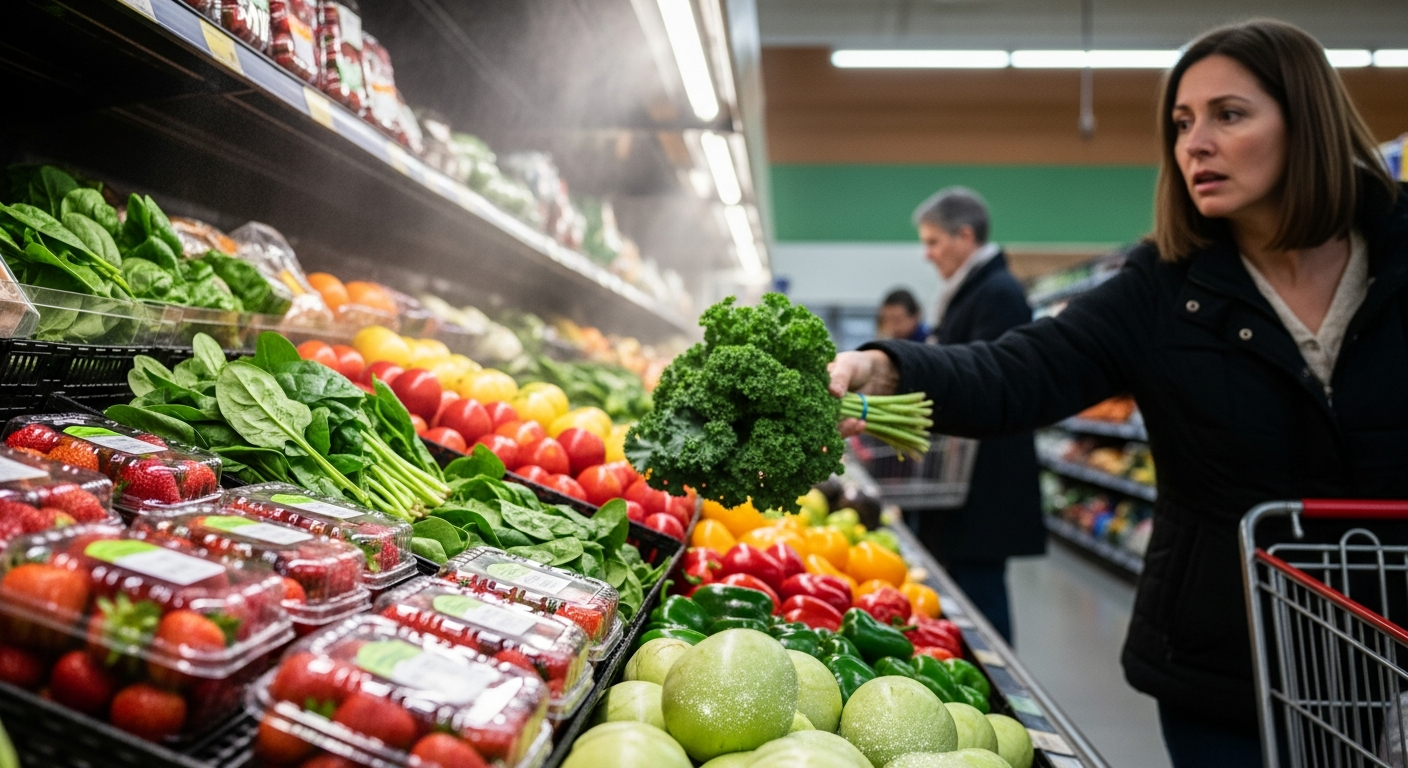
PFAS 'Forever Chemicals' Found on 63% of Dirty Dozen Produce
The fungicide coating your child's peach is classified as a PFAS "forever chemical," and washing it off is not an option. According to EWG's 2026 Shopper's Guide to Pesticides in Produce, 63% of samples from the Dirty Dozen list tested positive for PFAS pesticides. The primary culprit, fludioxonil, was found on nearly 90% of peaches, plums, and nectarines. It is applied after harvest to prevent mold, directly on the skin your family eats.
The Pesticide Coating Your Child's Fruit Is a PFAS Compound
PFAS (per- and polyfluoroalkyl substances) is a class of thousands of synthetic chemicals built around an extremely strong carbon-fluorine bond. That bond is what makes them "forever chemicals": they resist breaking down in the environment and accumulate in the body over time.
Fludioxonil fits that definition. It is a fluorinated fungicide applied post-harvest, meaning it goes on after the fruit is picked, directly to the surface of peaches, plums, nectarines, and other stone fruits. The goal is to prevent mold during storage and shipping. No amount of rinsing removes it. It bonds to the fruit skin, and it stays there.
The USDA's own testing found fludioxonil on 14% of all produce tested in its dataset. On stone fruits, the numbers are far higher. Nearly 90% of peaches, plums, and nectarines in EWG's analysis carried detectable fludioxonil residues.
The 2026 Dirty Dozen: PFAS Are Now Part of the Problem
EWG releases its annual Shopper's Guide to Pesticides in Produce each spring, ranking fruits and vegetables by pesticide load. The 2026 edition introduced a new finding: PFAS-classified pesticides are now a significant part of the contamination picture.
Researchers found 203 different pesticide chemicals across Dirty Dozen crops. Three PFAS pesticides ranked in the top 10 most frequently detected across all produce: fludioxonil, fluopyram, and bifenthrin. Together, they showed up on 63% of Dirty Dozen samples tested.
Spinach, kale, and collard and mustard greens topped the 2026 Dirty Dozen list. These crops consistently absorb and retain more pesticide residue than other vegetables, partly because of their thin, leafy surfaces and the way residues penetrate to the interior.
The pesticide problem extends beyond the Dirty Dozen. EWG found that 75% of all non-organic produce carries detectable pesticide residues. The Dirty Dozen designation simply marks the crops where contamination is heaviest and most consistent.
California's Farms Are Ground Zero
California grows the majority of fresh produce consumed in the United States. Roughly 40% of California-grown produce contains detectable PFAS, according to research covered by CNN and US News & World Report in March 2026. That makes this a national exposure issue, not a California-specific one.
If you buy your fruit at a grocery store anywhere in the country, the odds are high it came from California. And if it came from California, the odds are significant that it carries PFAS pesticide residue. That calculus is part of why researchers and consumer groups are pushing for federal action on PFAS in agriculture -- the supply chain is too interconnected for state-level regulation to contain the exposure.
What PFAS Pesticides Actually Do to the Body
The health concerns tied to PFAS exposure as a class include cancer, immune suppression, thyroid disruption, and reproductive harm. These are not theoretical risks -- they are the basis for the EPA's current PFAS drinking water limits, which were finalized in 2024 after decades of scientific review.
New research published in March 2026 adds another concern that is especially relevant for families with young children. Scientists found that early PFAS exposure is linked to reduced bone density in adolescent girls. The damage is not temporary. Girls exposed to higher PFAS levels during childhood showed measurably lower bone density as adolescents -- a finding that suggests the impact on skeletal development may be permanent.
Dietary exposure through produce is a real pathway, not a theoretical one. The produce sitting in your refrigerator is one of the primary ways PFAS pesticides enter the body. For children who eat stone fruits regularly, the cumulative exposure from post-harvest fludioxonil applications adds up across months and years of development.
What You Can Do Right Now
The most direct action is to buy organic for the Dirty Dozen. USDA Organic certification prohibits synthetic PFAS pesticides, including fludioxonil. Organic stone fruits are grown without post-harvest fungicide applications of this type. The price difference is real, but so is the difference in residue levels.
For produce where PFAS pesticide contamination is lower -- the Clean Fifteen -- buying conventional is a reasonable choice. Avocados, sweet corn, pineapple, onions, and cabbage consistently show low pesticide residues, and the financial tradeoff makes more sense.
One important gap in the Dirty Dozen framework: the risk doesn't disappear when fruit is processed into a packaged product. Organic fruit pouches, smoothie packs, and fruit snacks can still contain processed versions of Dirty Dozen crops. If the peaches or nectarines inside a packaged product came from conventional sources, the fludioxonil that was applied post-harvest is still present.
VeriFoods closes that gap. When you scan a packaged product, the app flags known PFAS risk based on the product's ingredients and sourcing data. If a fruit pouch contains conventional stone fruit, VeriFoods surfaces that risk even when the product label says nothing about it. Knowing the Dirty Dozen list is useful. Knowing whether this specific product is safe for your kid is better.
You cannot eliminate all PFAS exposure. These compounds are in water, in food packaging, and in the soil. But your family's daily produce choices represent one of the highest-volume dietary exposure pathways -- and that is one you can act on directly, starting with your next grocery run.
Stay ahead of the label.
Get early access to VeriFoods and be the first to see what's really in your food.
Sources
- Environmental Working Group - "EWG's 2026 Shopper's Guide: PFAS Pesticides on Produce" - March 2026. https://www.ewg.org/news-insights/news-release/2026/03/ewgs-2026-shoppers-guide-pesticides-producetm-finds-widespread
- CNN - "A surprising percentage of produce from the nation's largest supplier contains 'forever' pesticides" - March 11, 2026. https://www.cnn.com/2026/03/11/health/pfas-pesticides-california-produce-wellness
- US News & World Report - "Study Finds 'Forever Chemicals' on California Fruits and Vegetables" - March 13, 2026. https://www.usnews.com/news/health-news/articles/2026-03-13/study-finds-forever-chemicals-on-california-fruits-and-vegetables
- Science Daily - "PFAS 'forever chemicals' could be weakening kids' bones for life" - March 21, 2026. https://www.sciencedaily.com/releases/2026/03/260321004440.htm
Related Articles
FDA Detects PFAS in 7% of Food Samples as EPA Greenlights PFAS Pesticides on Crops
FDA testing found PFAS contamination in 7.2% of 542 food samples, including seafood, meat, dairy, and kale. Meanwhile,...
EPA Approves Pesticides Containing 'Forever Chemicals' for Corn, Apples, and Soybeans
Between April and June 2025, the EPA proposed approval of four new pesticides that qualify as PFAS 'forever chemicals'...