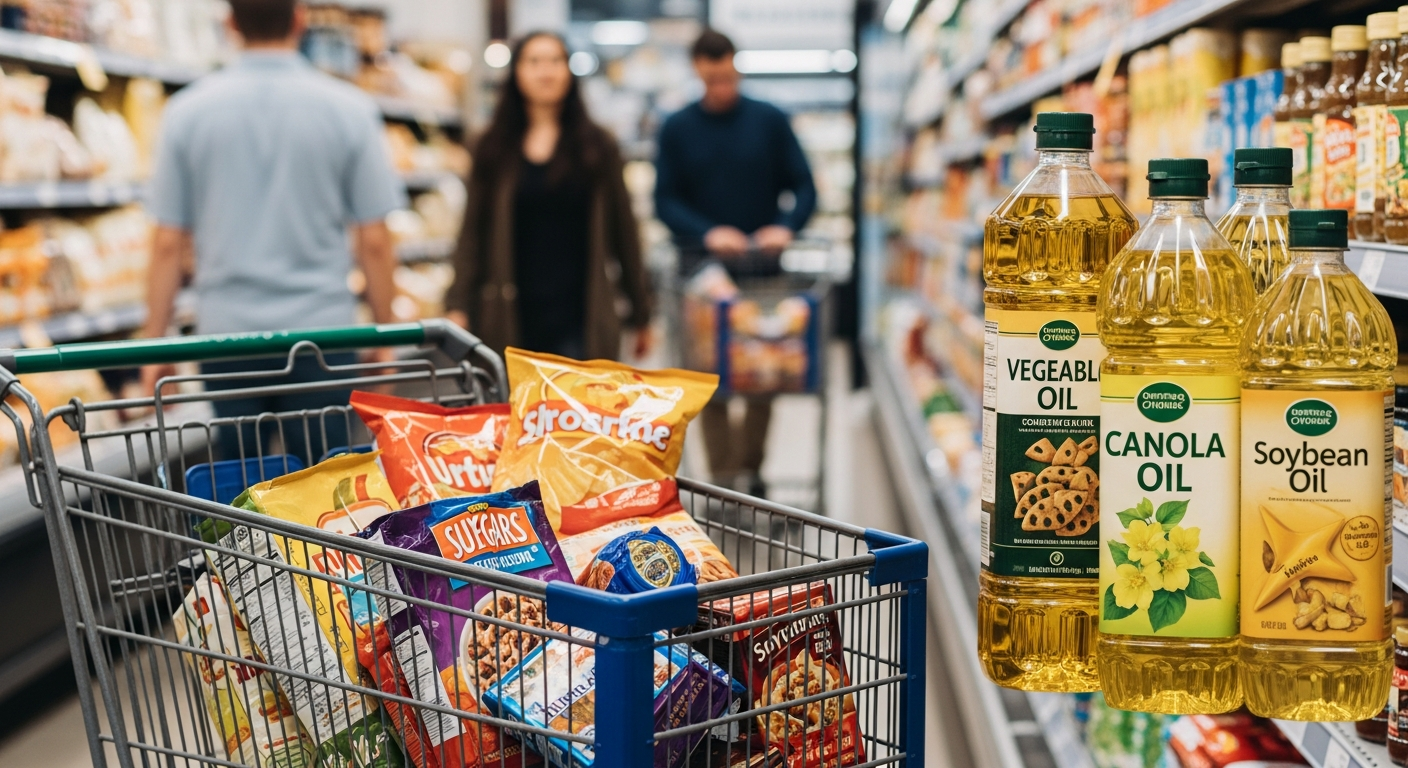
Federal Dietary Guidelines Now Warn Against Seed Oils and Ultra-Processed Foods
For decades, the federal government told Americans that vegetable and seed oils were heart-healthy alternatives to butter and animal fats. On January 7, 2026, that changed. The Trump Administration released the 2025-2030 Dietary Guidelines for Americans, and for the first time in the history of federal nutrition policy, the guidelines explicitly warn against ultra-processed foods and group seed oils alongside them as foods to limit. The document recommends natural oils like olive oil over processed seed oils, a direct reversal of advice that shaped American kitchens for generations.
Context
The Dietary Guidelines for Americans are jointly published every five years by the U.S. Department of Health and Human Services (HHS) and the U.S. Department of Agriculture (USDA). They set the foundation for federal nutrition programs, school lunch standards, food labeling requirements, and public health campaigns. When these guidelines change, the entire food system responds.
This edition represents what The New York Times called "the first significant federal nutrition policy reset in decades." The 2025-2030 guidelines depart from the nutrient-focused approach that dominated previous editions. Instead of evaluating foods solely by their fat, sugar, or sodium content, the new guidelines treat food processing itself as an independent risk factor. This aligns with the NOVA food classification system, a framework developed by researchers at the University of Sao Paulo that categorizes foods into four groups based on the degree of industrial processing they undergo.
The political context matters here. The Make America Healthy Again (MAHA) movement, a health-focused initiative backed by the Trump Administration, pushed for federal nutrition standards that account for food processing and ingredient quality. According to Politico, the MAHA movement's influence on these guidelines is now "codified at the highest regulatory level." Whether one agrees with the politics, the science behind limiting ultra-processed foods has been building for years. The guidelines simply caught up.
What Changed in the 2025-2030 Guidelines
The new dietary guidelines break from previous editions in several concrete ways.
Ultra-processed foods are named as a primary dietary concern. The guidelines cite their typically high levels of sodium, added sugars, unhealthy fats, and additives as reasons to limit them. This is not a vague suggestion. The document specifically identifies ultra-processed foods as a category Americans should actively reduce in their diets, according to the official HHS/USDA release.
Seed oils are grouped with ultra-processed foods as items to avoid. Previous guidelines recommended "vegetable oils" broadly without distinguishing between cold-pressed olive oil and industrially refined seed oils like soybean, canola, corn, and sunflower oil. The 2025-2030 edition draws that distinction for the first time, recommending natural oils (particularly olive oil) over their processed counterparts.
Perhaps most significant: the guidelines acknowledge that processing itself poses health risks independent of individual nutrient profiles. A food can be low in sodium and added sugar and still be problematic if it underwent extensive industrial processing. That reframes how the federal government evaluates dietary risk, moving the conversation beyond single-nutrient analysis toward a more complete picture of what Americans eat.
Why This Matters
The reversal on seed oils is decades in the making. Starting in the 1960s and accelerating through the 1980s, federal dietary advice pushed Americans away from saturated fats and toward polyunsaturated vegetable oils. Soybean oil, corn oil, and canola oil became staples of the American diet, appearing in everything from salad dressing to baby formula to restaurant fryers.
That advice shaped the food industry. Manufacturers reformulated products to replace butter, lard, and tropical oils with cheaper seed oils. The shift was so thorough that soybean oil alone now accounts for roughly 7% of total caloric intake in the U.S., according to USDA data.
The new guidelines signal that this era is ending at the policy level. The practical fallout is real: products marketed as "heart healthy" because they contain vegetable oils rather than saturated fats may no longer align with federal nutrition recommendations. Reading ingredient labels just became more important, not less.
For people who have already been skeptical of seed oils (a position often dismissed as fringe until now), the guidelines offer official validation. The federal government is saying what independent researchers and consumer advocates have argued for years: the type of processing matters, and industrial seed oils deserve scrutiny.
Industry Impact
Food manufacturers face real reformulation pressure. Products that rely on soybean oil, canola oil, or other refined seed oils as primary ingredients will need to reckon with federal guidelines that now recommend alternatives. This is not just a labeling issue. It affects formulation, sourcing, and marketing.
Products currently positioned as health-conscious (protein bars, plant-based milks, cooking sprays) often use seed oils as a base ingredient. Those brands now face a choice: reformulate with oils the guidelines endorse, like olive or avocado oil, or continue using seed oils while federal nutrition advice points consumers in the other direction.
Restaurants face a similar reckoning. Seed oils dominate commercial kitchens because they are cheap and handle high heat well. Switching to olive oil or avocado oil would raise costs across menus. How fast the industry moves is an open question, but the federal signal leaves little room for ambiguity.
What This Means for You
The practical question is simple: how do you know which products in your pantry rely on the seed oils and ultra-processed ingredients the guidelines now warn against?
VeriFoods already classifies every scanned product using the NOVA system, the same framework that underpins the new federal guidelines. The app flags seed oil content and identifies ultra-processed foods at the point of purchase. What started as a feature for health-conscious early adopters now aligns with official U.S. dietary policy.
Checking your pantry staples takes minutes. Scan a few products you buy regularly and look at the NOVA classification and seed oil flags. The results often surprise people. Products marketed as healthy, including many granola bars, flavored yogurts, and salad dressings, frequently contain the very ingredients the 2025-2030 guidelines recommend limiting.
The federal government has drawn a line. Ultra-processed foods and seed oils are no longer endorsed as part of a healthy American diet. The foods these guidelines warn about are already sitting in most American kitchens. The question is whether consumers have the tools to identify them.
Stay ahead of the label.
Get early access to VeriFoods and be the first to see what's really in your food.
Sources
- U.S. Department of Health and Human Services / USDA - "Dietary Guidelines for Americans 2025-2030" - January 7, 2026. https://www.dietaryguidelines.gov/2025-2030
- The New York Times - "Dietary Guidelines Warn Against Ultra-Processed Foods and Seed Oils" - January 7, 2026. https://www.nytimes.com/2026/01/07/health/dietary-guidelines-ultra-processed-seed-oils.html
- Politico - "Trump Administration Dietary Guidelines Target Ultra-Processed Foods and Seed Oils" - January 7, 2026. https://www.politico.com/news/2026/01/07/trump-dietary-guidelines-ultra-processed-foods-seed-oils-00197234
Related Articles

BHA Has Been a Probable Carcinogen for 30 Years. The FDA Is Finally Acting.
The National Toxicology Program classified BHA as a probable human carcinogen in the 1990s. It kept appearing on...

Walmart voluntarily phasing out synthetic dyes in their private label brands
By VeriFoods Walmart has announced a major shift in its approach to food ingredients, pledging to eliminate synthetic...

Arizona Bans 11 Food Additives in School Meals, a First for Any U.S. State
On April 14, 2025, Arizona Governor Katie Hobbs signed House Bill 2164 into law, making Arizona the first state in the...