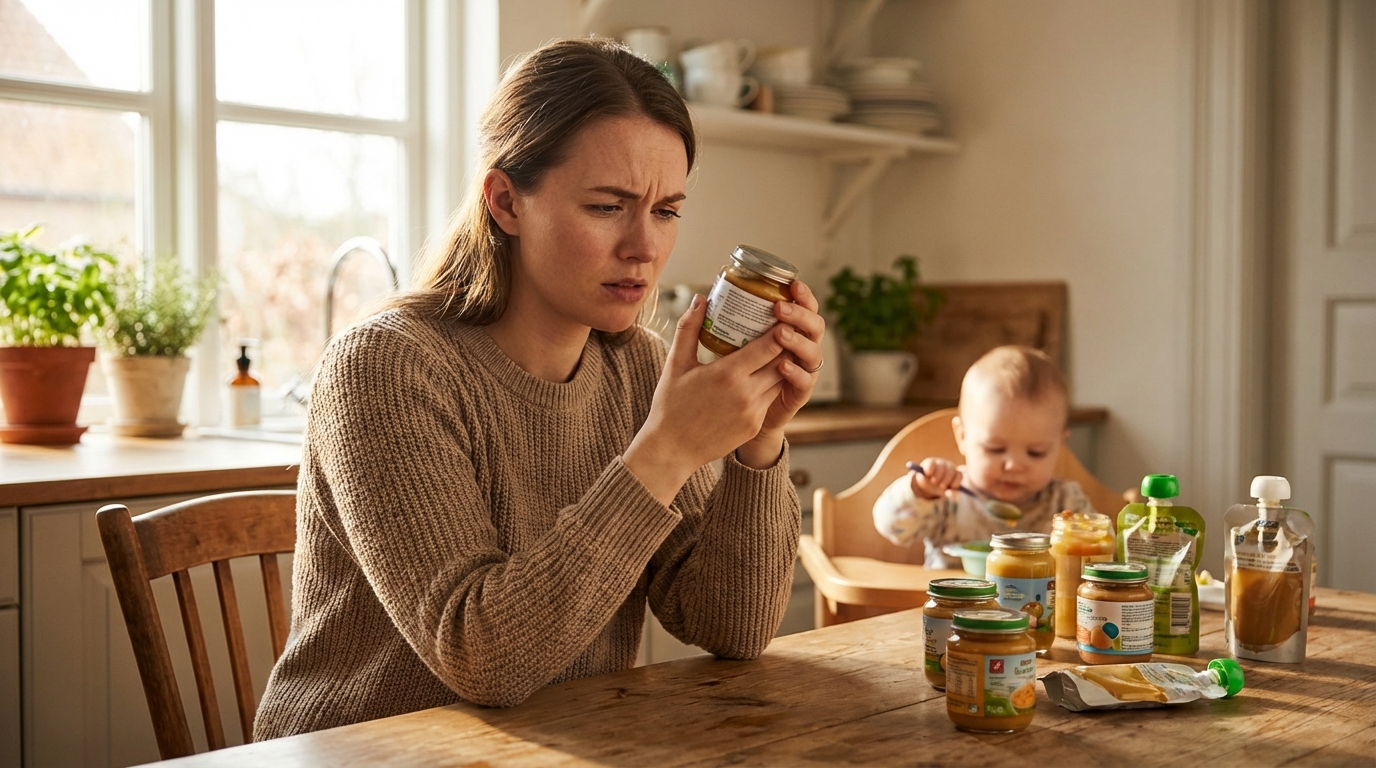
FDA Sets First Lead Limits for Baby Food as California Forces Transparency
On January 6, 2025, the FDA set specific limits on how much lead can be in baby food for the first time. The action levels cap lead at 10 parts per billion (ppb) for most baby foods and 20 ppb for root vegetables and dry infant cereals. Five days earlier, California became the first state to require baby food manufacturers to disclose heavy metal testing results through QR codes on packaging.
These two actions represent the most significant regulatory push on baby food safety in years. But a closer look reveals gaps that leave millions of children exposed.
The Health Stakes
Lead is a neurotoxin. There is no safe level of exposure for children. Even low concentrations can impair cognitive development, reduce IQ, and cause behavioral problems. The damage is irreversible.
A 2021 Congressional investigation brought the crisis into public view when it found lead contamination as high as 641 ppb in baby food products sold by major brands. That figure is "64 times higher than that advised under the recently issued guidance," according to legal analysis from Morrison Foerster. The investigation prompted the FDA to launch its "Closer to Zero" initiative, which aims to reduce dietary exposure to lead, arsenic, cadmium, and mercury in foods eaten by babies and young children.
Four years later, the first concrete output of that initiative has arrived: final guidance on lead limits. But the word "guidance" matters. These are recommendations, not laws.
The FDA''s New Lead Limits: What They Cover and What They Don''t
The FDA''s final guidance, announced January 6, 2025, establishes action levels for lead in processed foods intended for children under two years old:
- 10 ppb for fruits, vegetables (excluding root vegetables), grain-based and meat-based mixtures, yogurts, custards, puddings, and single-ingredient meats
- 20 ppb for single-ingredient root vegetables (like sweet potatoes and carrots) and dry infant cereals
These limits apply to packaged, processed baby foods sold in jars, pouches, tubs, and boxes. The FDA tested 689 samples of processed baby food. Ninety percent had lead levels below 10 ppb, and 94% fell under the proposed caps. The agency estimates the new action levels could reduce lead exposure risk by approximately 27%, according to FoodNavigator-USA.
The problem: these action levels are voluntary. The FDA defines them as levels "at which FDA may regard the food as adulterated," according to Morrison Foerster''s legal analysis. They function as internal enforcement benchmarks, not legally binding limits. Manufacturers face no automatic penalty for exceeding them, though the FDA retains discretion to take action.
The Exemptions
The guidance excludes several major categories:
- Infant formula, despite accounting for approximately 26% of babies'' total dietary lead exposure, according to analysis by Unleaded Kids citing Healthy Babies Bright Futures data
- Beverages marketed to children
- Snack foods like puffs and teething biscuits
- Raw agricultural commodities and homemade foods, which together account for 51.4% of children''s lead exposure
That means the FDA''s new guidance covers less than a quarter of the total dietary lead that babies actually consume.
Most Products Already Comply
According to Unleaded Kids, an estimated 91% of dry infant cereals already meet the 20 ppb level. For single-ingredient root vegetables, 88% comply. For all other baby foods, 97% are already below 10 ppb.
If the vast majority of products already comply, how much will these limits change?
Thomas Galligan of the Center for Science in the Public Interest acknowledged the step forward while criticizing its pace: "FDA''s actions today are a step forward and will help protect children. However, the agency took too long to act."
The final guidance is unchanged from the draft version released in January 2023. It took two years to finalize, with no substantive changes. Consumer attorney Vineet Dubey said the caps are "not as low as I would like to see" but called them "meaningful protection," according to FoodNavigator-USA.
How the U.S. Compares to Europe
The European Union has taken a different approach. According to Unleaded Kids'' analysis, the EU established enforceable maximum limits of 20 ppb across virtually all baby foods, with no major exemptions. These are binding regulations, not voluntary guidance. The EU''s framework covers infant formula and does not carve out exceptions for snack foods or beverages.
The FDA''s guidance asks nicely. The EU''s regulations require compliance.
California''s AB 899: The Transparency Experiment
While the FDA issued recommendations, California enacted a law.
AB 899 took effect on January 1, 2025, making California the first state to require baby food manufacturers to test their products monthly for four heavy metals: arsenic, cadmium, lead, and mercury. Testing must be conducted at accredited laboratories, and results must be disclosed publicly on company websites and through QR codes on product packaging. The law requires testing to a detection level of 6 ppb for each metal.
The concept is straightforward: parents scan a QR code on a jar of baby food and see exactly what contaminants were detected. That kind of transparency did not exist anywhere in the U.S. before January 2025.
The Compliance Reality
The law is on the books. Compliance is another story.
According to C. Michael White, a Distinguished Professor of Pharmacy Practice at UConn, "only four companies out of 28 were fully in compliance" when AB 899 took effect. Many firms had built no infrastructure at all. Others created websites but loaded no heavy metal data. Some provided test results only through batch number entry rather than QR codes on packaging, forcing consumers to already have the product before they could check what was in it.
The four companies fully compliant at launch were Plum Organics, Lil'' Gourmets, Once Upon a Farm, and Square Baby. All voluntarily posted 2024 testing results before the deadline, according to Unleaded Kids. Seven manufacturers (Fresh Bellies, Lil'' Gourmets, Little Spoon, Plum Organics, Ready Set Food, Serenity Kids, and Square Baby) used labs capable of detecting levels at 3 ppb or lower, well below the law''s 6 ppb threshold.
On the other end, companies like Cerebelly and Little Spoon posted test results but required consumers to enter lot numbers. That "contradicts the law''s intent since online shoppers cannot access packaging before buying," according to Unleaded Kids.
Products manufactured before January 1, 2025, that don''t meet the new requirements are not required to be removed from retail shelves, according to ABC7. Non-compliant products could remain on store shelves for months.
Signs of Momentum
Despite the rocky rollout, major manufacturers are voluntarily extending the law beyond California''s borders.
According to ABC7''s reporting, Gerber (owned by Nestle) and Beech-Nut committed to rolling out QR-coded products nationwide, not just in California. Gerber stated that "all testing results can be found by scanning the QR code on the product label or by visiting Gerber.com." Beech-Nut goes further, screening for "up to 255 pesticides, toxins, and other environmental elements" in addition to heavy metals.
Jaclyn Bowen, Executive Director of the Clean Label Project, told Pure Earth: "AB-899 sets a critical benchmark for baby food manufacturers, many of whom are already rejecting lots with elevated heavy metals to meet these stringent new standards."
That statement carries an important implication. If manufacturers are rejecting lots, contaminated products were reaching shelves before. The law is changing behavior.
How Big Is the Problem?
Heavy metal contamination in baby food is widespread and well-documented.
Consumer Reports testing found that 33 of 50 baby food products contained concerning levels of at least one heavy metal, according to a 2018 study cited by UConn Today. Follow-up testing in 2023 showed improvement in three products, no change in one, and slight increases in three of the seven retested. Progress is uneven.
The FDA''s own research found that more than 2.6 million children (roughly 1 in 10 across age groups from birth through six years old) consume at least 2.4 micrograms of lead daily. That exceeds the agency''s interim reference level of 2.2 micrograms per day, according to Unleaded Kids'' analysis of FDA data.
Heavy metals enter baby food through contaminated soil, volcanic eruptions, fossil fuel exhaust (particularly from decades of leaded gasoline use), synthetic fertilizers, rinse water, and air-drying exposure during processing, according to UConn Today. Crops that accumulate metals readily include sweet potatoes, carrots, apples, rice, and cinnamon. These are among the most common baby food ingredients.
What Parents Can Do Right Now
The FDA''s new guidance and California''s transparency law are steps in the right direction. They are not enough.
Check the QR codes. If you buy baby food from Gerber, Beech-Nut, Plum Organics, or other brands that have adopted QR code disclosure, scan the code and read the results. Look for lead, arsenic, cadmium, and mercury levels. Lower is better. Non-detect is best.
Diversify your baby''s diet. The FDA recommends feeding babies a variety of foods from all five food groups. This limits exposure to any single contaminant source. Sweet potatoes and rice cereal are common in baby food, but they also accumulate heavy metals more readily.
Know what''s excluded. Infant formula, snack foods like puffs and teething biscuits, and beverages are not covered by the new FDA guidance. If your child consumes these products, no federal action levels apply.
Don''t rely solely on manufacturer self-reporting. California''s AB 899 requires companies to report their own test results, which is better than nothing. But independent testing provides a second set of eyes. Apps like VeriFoods let consumers scan product barcodes and check whether items have been independently tested for contaminants like heavy metals and pesticides, providing data that doesn''t come from the manufacturer.
Watch for the "organic" assumption. Organic certification does not guarantee low heavy metal levels. Heavy metals enter food through soil and water contamination, processes that organic farming practices do not fully prevent. Several organic brands have been flagged in testing for heavy metal levels comparable to or exceeding conventional products.
What Comes Next
The FDA has indicated that action levels for arsenic, cadmium, and mercury in baby food are still in development under the Closer to Zero initiative. Lead was first. The others will follow, though no timeline has been announced.
California''s AB 899 will face its real test over the coming months as manufacturers ramp up compliance. The 24 companies that were not fully compliant at launch will face increasing pressure to build out their QR code infrastructure and post test results.
For now, the burden of protecting children from heavy metals in food falls on the parents who buy it. The regulations are getting better. They are not yet good enough.
Stay ahead of the label.
Get early access to VeriFoods and be the first to see what's really in your food.
Sources
- FDA Issues Final Guidance for Industry on Action Levels for Lead in Processed Food Intended for Babies and Young Children - U.S. Food and Drug Administration, January 6, 2025
- FDA finalizes lead caps for baby food - FoodNavigator-USA, January 7, 2025
- FDA Issues Action Levels for Lead in Baby Food - Morrison Foerster, January 13, 2025
- Lead in Baby Food: FDA Sets Action Levels, But Loopholes Limit Impact - Unleaded Kids, January 15, 2025
- Baby food labels will reveal levels of lead and other heavy metals for first time - ABC7 / CNN, January 2025
- Lead in Baby Food: California Requires Companies to Disclose Heavy Metal Levels - Unleaded Kids, January 2, 2025
- Parents Can Soon Use QR Codes to Reveal Heavy Metal Content in Baby Food - UConn Today, February 21, 2025
- Heavy Metals in Baby Food: How this California Regulation Will Make Children Safer - Pure Earth, February 5, 2025
Related Articles
EU Banned Titanium Dioxide in Food; It's Still in 11,000+ US Products Including Popular Candy
New research raises fresh concerns about a whitening chemical the EU banned three years ago. It's still in your candy...
Heavy Metals Found in 65% of Baby Foods Worldwide, Rice and Soy the Worst
Lead, cadmium, and arsenic contaminate the majority of baby foods and infant formulas sold worldwide. That is the...
Over 60% of Baby Foods Worldwide Contain Heavy Metals, New Study Finds
A comprehensive review of 75 studies found that more than 60% of baby foods and infant formulas worldwide contain...