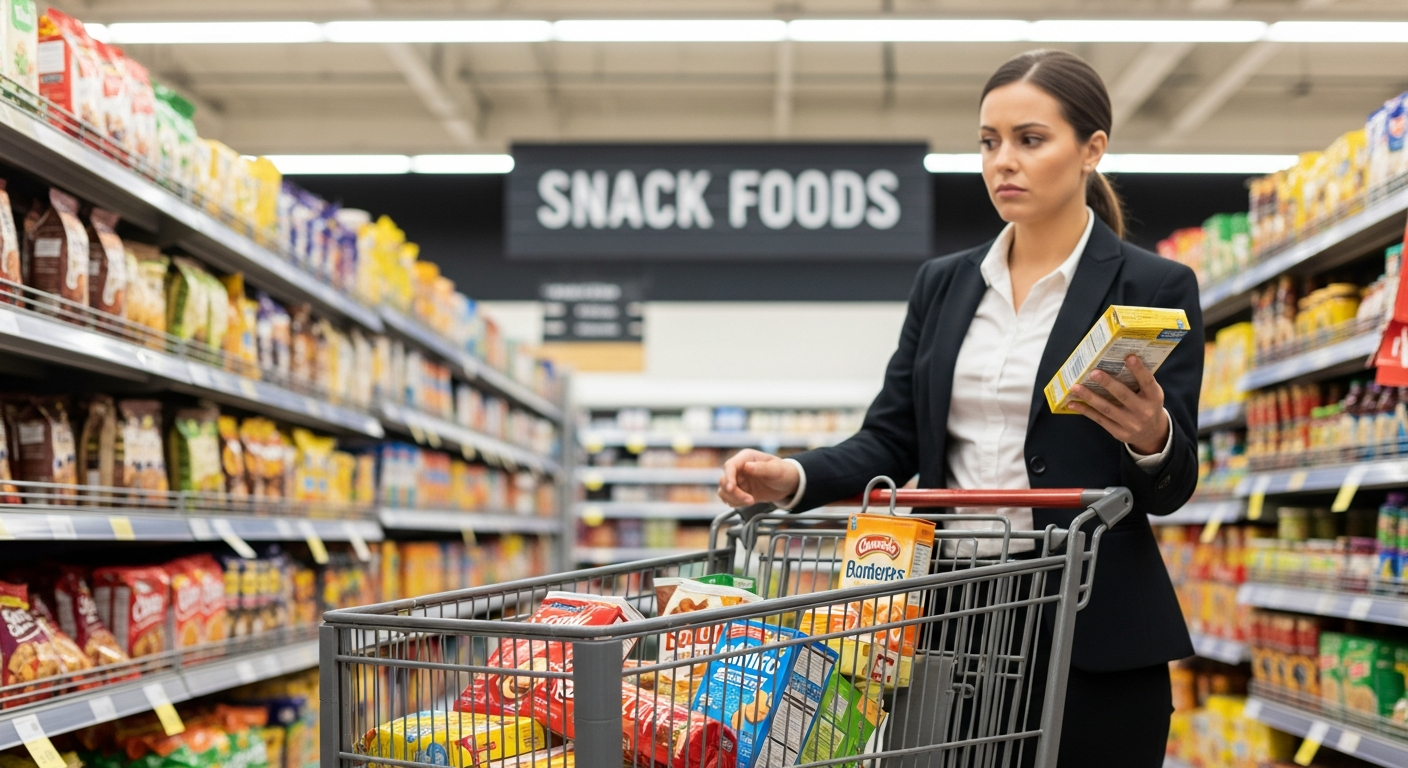
100+ Chemicals Were Added to Your Food Without FDA Review
Food companies can legally add chemicals to your food without ever telling the FDA or the public. That is not a scandal waiting to break. It is the law. A March 2026 investigation by the Environmental Working Group identified 111 food chemicals that entered the US food supply this way -- without any government notification, review, or approval. Forty-nine of those substances are already present in thousands of consumer products on store shelves right now. One of them has been linked to fetal leukemia and brain defects in developing fetuses. It is in dozens of products. It is unreviewed and untracked. And until this investigation, most people had no idea it existed.
Context
The legal mechanism at the center of this is called GRAS, which stands for "Generally Recognized As Safe." Congress created the GRAS designation in 1958 as a practical shortcut for substances nobody needed to study -- table salt, vinegar, basic spices. The idea was that some ingredients are so well-established and widely used that requiring formal FDA approval for each one would be a waste of everyone's time.
That made sense in 1958. What happened next did not.
Over the following decades, the food industry developed a variation called "self-affirmed GRAS." Under this approach, a company convenes its own panel of experts, those experts decide the substance is safe, and the company adds it to food products. No FDA filing. No public notice. No government oversight of any kind. The FDA does maintain a formal GRAS notification pathway -- but that one is voluntary, too. Even when companies use it, the agency only reviews a summary; it does not independently test the substance.
Nearly 99% of food chemicals introduced since 2000 entered the market through the self-affirmation pathway, according to prior EWG analysis. The FDA has repeatedly acknowledged, in its own communications, that it does not know what chemicals are in the food supply under this process. The agency has no complete list. There is no central registry. No searchable database. Just thousands of private company decisions with no public record attached to them.
The Findings
The EWG's March 2026 investigation examined the USDA Branded Foods Database -- the most comprehensive record of ingredients in US consumer products -- and cross-referenced it against chemicals introduced through self-affirmed GRAS declarations that were never submitted to the FDA.
The results: 111 food chemicals entered the US food supply without FDA knowledge. Of those, 49 are already showing up in thousands of products across major retail categories. Sports drinks, snack bars, breakfast cereals, and processed beverages were among the product types most affected. These products are on shelves at major retailers. Their labels do not identify which ingredients entered the food supply without review. There is no legal requirement that they do.
CNN, reporting on the investigation in March 2026, framed it plainly: companies are adding chemicals of unknown safety to the US food supply without FDA or public knowledge. The story ran nationally. It was not a niche food policy story. It was a mainstream news headline -- because the finding was that basic and that alarming.
What Experts Say
The EWG investigation does not just count chemicals. It flags specific substances with documented safety concerns. One example stands out.
A variant of green tea extract entered the food supply through self-affirmed GRAS and is now present in dozens of consumer products. Research has linked this specific variant to fetal leukemia, heart and brain defects during fetal development, liver damage, kidney damage, and intestinal harm. It is not a banned substance. The FDA has not reviewed it. It is legal, in products you can buy today, and most consumers have no way of knowing it is there.
This is not a fringe chemical buried in an obscure product. It appears broadly enough that EWG flagged it as one of the most alarming examples from the full set of 111 substances.
Food Safety Magazine, covering the investigation's release, noted the scale of the problem: more than 100 substances have been used in foods without FDA notification, a figure that represents a structural failure of the regulatory system rather than isolated incidents. The New Lede, which covers food and environmental accountability journalism, reported that companies are declaring these substances safe based entirely on their own internal assessments -- assessments the public cannot access and the government never sees.
What This Means for You
Two things are changing in Washington -- both in early stages, neither finalized.
The FDA announced it is proposing a mandatory GRAS notification requirement for the first time in the program's history. Under the proposal, companies would have to inform the agency when they declare a substance GRAS, even through self-affirmation. That would close the information gap going forward.
Separately, Health Secretary RFK Jr. directed the FDA to eliminate the self-affirmed GRAS pathway entirely. If that direction becomes policy, companies would no longer be able to introduce new food chemicals without government involvement.
Both moves represent more regulatory attention to this issue than the food industry has seen in decades. But neither addresses the 111 substances already in the food supply. Even if new rules pass tomorrow, they do not trigger a retroactive review of what is already in products on shelves.
That is the problem consumers face right now. The label on a sports drink or snack bar does not tell you whether its ingredients were reviewed by the FDA, declared safe by the company's own hired experts, or introduced through a process the government cannot track. Reading ingredient lists helps, but most of these chemicals appear under technical additive names that provide no signal about their review history.
VeriFoods' additive analysis scans a product's full ingredient list and flags substances with known safety concerns, limited review history, or regulatory gaps -- including chemicals that entered the food supply through self-affirmed GRAS without federal review. Scan any product in the VeriFoods app to see its full additive profile. The ingredient list on the package tells you what's in the product. The app tells you what that actually means.
Stay ahead of the label.
Get early access to VeriFoods and be the first to see what's really in your food.
Sources
- EWG - "Secret GRAS: How 100+ Food Chemicals Bypassed Government Safety Review" - March 2026. https://www.ewg.org/research/secret-gras-how-100-food-chemicals-bypassed-government-safety-review
- EWG - "Secret Food Chemicals: New Analysis Finds Over 100 Unreviewed Additives" - March 2026. https://www.ewg.org/news-insights/news-release/2026/03/secret-food-chemicals-new-analysis-finds-over-100-unreviewed
- CNN - "Chemicals of unknown safety added to US food supply without FDA or public knowledge" - March 3, 2026. https://www.cnn.com/2026/03/03/health/secret-food-additives-investigation-wellness
- Food Safety Magazine - "Investigation Identifies More than 100 GRAS Ingredients Used in Foods Without FDA Notification" - March 2026. https://www.food-safety.com/articles/11199-investigation-identifies-more-than-100-gras-ingredients-used-in-foods-without-fda-notification
- The New Lede - "Report Finds Over 100 Food Chemicals Companies Declared Safe Without Notifying FDA" - March 2026. https://www.thenewlede.org/2026/03/report-finds-over-100-food-chemicals-companies-declared-safe-without-notifying-fda/
Related Articles
The FDA Promised to Ban Artificial Food Dyes. Instead, It Rewrote the Rules.
The FDA quietly abandoned its pledge to eliminate six synthetic food dyes by 2026, pushed the deadline to 2027, and...
FDA Launches Major Post-Market Review of Food Chemicals Approved Decades Ago
The FDA announced its most significant expansion of food chemical oversight in decades, targeting legacy chemicals like...