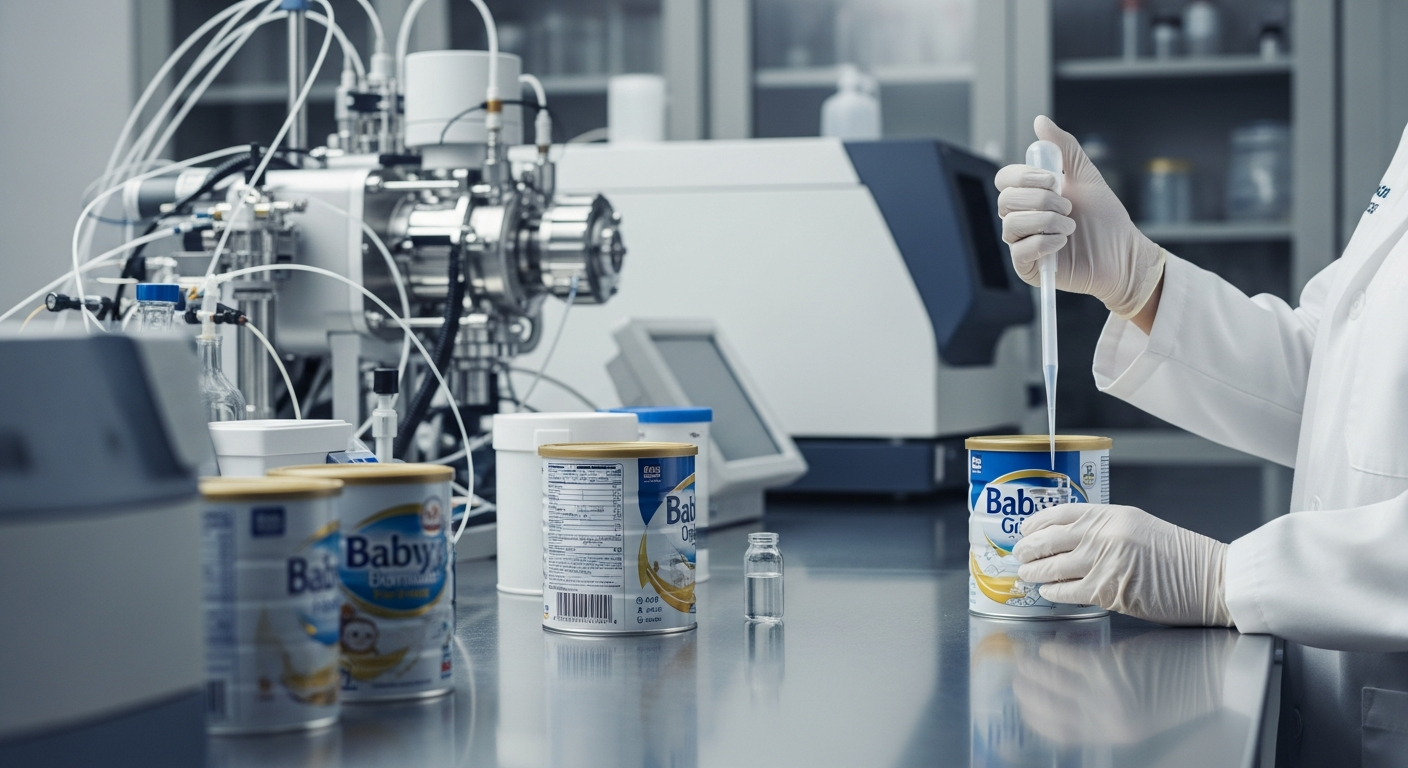
Consumer Reports Tests 49 Baby Formulas, Finds Heavy Metals in Over Half
Consumer Reports tested 49 baby formulas sold across the United States and found that more than half contained arsenic, lead, or PFAS at levels the organization considers concerning. The products tested include powdered, liquid concentrate, ready-to-feed, and alternative protein formulas, including hypoallergenic options, from brands that line the shelves of every major pharmacy and grocery store. For parents who rely on formula as their infant's sole source of nutrition for the first months of life, the findings present a serious question with no easy answer: what is actually in the formula they feed their baby every day?
What Consumer Reports Found
The testing covered 49 products across four formula categories: powdered, liquid concentrate, ready-to-feed, and alternative protein. Of those 49 formulas, 26 contained inorganic arsenic at or above Consumer Reports' level of concern. Three powdered formulas exceeded CR's concern threshold for lead. PFAS, the class of synthetic chemicals often called "forever chemicals," were detected in more than a quarter of formulas tested.
Both Similac and Enfamil, the two most recognized names in infant formula, had products appear at both ends of the rankings. Some of their formulas performed well; others did not. The variation was not simply brand-to-brand but product-to-product within the same brand family.
Bobbie, a smaller organic formula brand, was a standout performer across its full product line. Its consistent results suggest that lower contamination levels are achievable through careful sourcing.
One critical caveat: Consumer Reports sets its own "level of concern" thresholds based on health data and precautionary principles. These are not legal limits. The federal government has set no enforceable maximum for arsenic, lead, cadmium, or mercury in infant formula. A product can exceed Consumer Reports' concern threshold and still be fully compliant with U.S. law.
Why No Federal Limits Exist
Infant formula occupies a strange regulatory gap. Pesticide residue limits exist for produce. Contaminant limits exist for bottled water, drinking water, and many other foods. Infant formula, despite being the exclusive diet of millions of American infants, has no enforceable federal maximum for heavy metals.
The FDA has acknowledged this gap. As part of its 2026 food safety agenda, the agency has committed to establishing action levels for cadmium and inorganic arsenic in baby and toddler foods. "Action levels" are not hard legal limits; they are guidance thresholds that can trigger enforcement action, but manufacturers are not automatically in violation if they exceed them. Enforcement timelines remain unclear.
A separate federal effort, called Operation Stork Speed and announced by Health Secretary RFK Jr., is conducting a broader heavy metals review of infant and toddler products. Results are expected in April 2026, which means parents reading the Consumer Reports data right now are ahead of any regulatory response.
At the state level, California and Virginia have enacted baby food disclosure laws requiring manufacturers to publish testing results for heavy metals. The approach creates a state-by-state patchwork rather than a national standard, but it does give parents in those states access to information that parents elsewhere cannot get.
In the absence of federal limits, compliance is entirely voluntary. Brands that test rigorously and source carefully are operating on their own initiative, not under legal obligation.
What Heavy Metals Do to Infants
Inorganic arsenic is classified as a Group 1 carcinogen by the International Agency for Research on Cancer, meaning there is sufficient evidence it causes cancer in humans. In infants and young children, exposure is also linked to impaired neurodevelopment and reduced IQ. The brain develops rapidly in the first two years of life, and disruptions during that window can have lasting effects.
Lead has no safe level of exposure for children. The CDC eliminated the concept of a "safe" blood lead level more than a decade ago, recognizing that even low-level exposure affects brain development, behavior, and learning. Lead exposure in early childhood has been linked to reduced cognitive function and increased risk of behavioral disorders.
PFAS are a family of thousands of synthetic chemicals used in manufacturing, firefighting foam, and food packaging, among other applications. They are called "forever chemicals" because they do not break down in the human body or the environment. In infants, PFAS exposure is associated with immune suppression, hormonal disruption, and developmental delays. The CDC has found PFAS in the blood of 97% of Americans, meaning essentially every adult in the country carries some level of exposure from years of accumulated contact with these compounds.
The concern for formula-fed infants is compounded by concentration. An adult eating a varied diet absorbs contaminants across dozens of different foods. A formula-fed infant consumes one product, multiple times daily, for months on end. Their body weight is also far lower than an adult's, which means any given dose represents a larger exposure relative to their size. The same arsenic level that might be acceptable in a food adults eat occasionally becomes a different calculation when an infant consumes it as their entire diet, every day, for the first six months of life.
What Experts Say
Consumer Reports' methodology drew on established health-based thresholds developed by the Environmental Protection Agency, the European Food Safety Authority, and the World Health Organization. The organization's researchers applied precautionary standards appropriate for the population consuming the product: infants with developing neurological systems and immature detoxification capacity.
Pediatric health researchers have consistently argued that the regulatory gap around infant formula contaminants is not a data problem but a political one. The science on arsenic and lead in early childhood is not contested. The toxicology is well-established. What has been missing is the legislative and regulatory will to set enforceable limits for a product marketed directly to parents as safe.
What This Means for You
Not every formula on store shelves is equally contaminated. The Consumer Reports testing identified clear differences across products, and those differences exist even within major brand families. Parents are not choosing between two equally bad options; they are choosing among products with meaningfully different contamination profiles.
Practical steps parents can take now include checking Consumer Reports' published product-by-product results by formula name, looking for third-party testing certifications on packaging, and scanning the formula barcode in the VeriFoods app. VeriFoods aggregates lab testing data across heavy metals, PFAS, pesticides, and other contaminants, and assigns safety ratings by product. Scanning a barcode gives an immediate view of how a specific formula ranks, without waiting for a federal review or a state disclosure law to catch up.
Bobbie's strong performance across all products tested shows that better outcomes are available at retail. Parents willing to compare options have real choices.
What's Coming Next
FDA results from Operation Stork Speed are expected in April 2026. That announcement will likely generate significant coverage and may prompt faster action on the proposed cadmium and arsenic action levels. Parents should watch for those results, which could provide the clearest federal picture yet of the contamination problem in infant and toddler products.
The California and Virginia disclosure models may spread. Several other states have introduced similar legislation, and the Consumer Reports findings will almost certainly be cited in those debates. If more states pass disclosure requirements, brands that have not been testing consistently will face pressure to either publish results or reformulate.
Federal action levels, even when they arrive, will not eliminate contamination. They will establish a legal floor, not guarantee zero exposure. Regulatory change is slow and the gap between a concerning finding and an enforceable limit is measured in years, not months.
The data, however, exists now. Until federal limits are in place, parents do not have to wait for the government to act. The testing has been done. The results are public. Until federal limits exist, the data already does. Scan your formula in VeriFoods before the next feeding.
Stay ahead of the label.
Get early access to VeriFoods and be the first to see what's really in your food.
Sources
- Consumer Reports - "We Tested 49 More Baby Formulas for Lead and Arsenic" - March 2026. https://www.consumerreports.org/babies-kids/baby-formula/liquid-baby-formula-contaminants-test-results-a8639602154/
- CBS News - "Some baby formula brands contain lead, arsenic and other heavy metals, Consumer Reports says" - March 2026. https://www.cbsnews.com/news/baby-formula-heavy-metals-contamination-testing-consumer-reports/
- Axios - "Consumer Reports finds heavy metals in more than half of baby formulas tested" - March 3, 2026. https://www.axios.com/2026/03/03/consumer-reports-baby-formula-heavy-metals
Related Articles

New Study: BPA Substitute BPS Damages Sperm Development in Offspring
A new peer-reviewed study finds that maternal exposure to Bisphenol S, the most common BPA replacement, impairs...

BHA Has Been a Probable Carcinogen for 30 Years. The FDA Is Finally Acting.
The National Toxicology Program classified BHA as a probable human carcinogen in the 1990s. It kept appearing on...

100+ Chemicals Were Added to Your Food Without FDA Review
A March 2026 EWG investigation identified 111 food chemicals that entered the US food supply without the FDA ever being...